Introduction
Have you ever said “yes” when everything in your body screamed “no”? Do you find yourself over-apologizing, avoiding conflict, and constantly seeking approval—even at the cost of your own peace of mind? If so, you might not be genuinely kind… just stuck being nice.
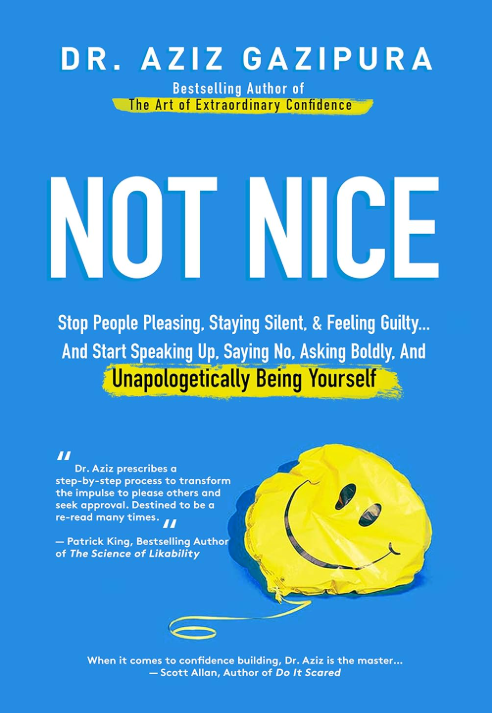
In Not Nice: Stop People Pleasing, Staying Silent, and Feeling Guilty… And Start Speaking Up, Saying No, Asking Boldly, and Unapologetically Being Yourself, Dr. Aziz Gazipura delivers a powerful wake-up call. He makes a strong case that “niceness” is not compassion—it’s fear. And that fear stops you from living fully, speaking truthfully, and standing confidently in your life.
1. The Problem with Being “Nice”
Most people confuse being nice with being good. But niceness is often a cover-up for something darker: the fear of rejection, discomfort, or not being liked. It involves hiding who you are to gain approval from others. It leads to…
- Bottled-up resentment
- Social anxiety
- Inauthentic relationships
- Guilt and shame for wanting different things
- Emotional exhaustion
The biggest tragedy? You never show the world who you really are.
2. People-Pleasing Isn’t Effective—And People See Through It
You might think being endlessly agreeable makes you likable. But in reality, people respect honesty, confidence, and clarity far more than fake politeness. When you constantly try to make others happy, they sense the inauthenticity—and often pull away. Ironically, being overly “nice” actually creates distance.
3. The Turning Point: Life Requires Boldness
Sometimes it takes a major life event or emotional breaking point to realize that something has to change. When you do finally commit to living authentically, you generate energy—raw, unstoppable motivation to go after the life you truly want.
4. Why We Seek Approval
Most of us were conditioned from childhood to be agreeable, compliant, and self-sacrificing. We were taught that voicing disagreement, setting boundaries, or asking for more made us selfish or “bad.” That deeply ingrained programming leads to a life driven by guilt and fear instead of purpose and truth.
5. Start Showing Up Authentically
Rather than obsessing over what others think, show up in the world as your full self. Don’t dilute your personality to fit in—embrace your uniqueness. The truth is, not everyone will like you. And that’s okay. There’s a “tribe” out there who will. But you won’t find them if you’re constantly playing a role to gain general approval.
6. Understand the Difference Between Guilt Types
There are two forms of guilt:
- Appropriate guilt: When your actions go against your core values (e.g., lying to someone you care about).
- Inappropriate guilt: When you feel bad simply for honoring your own needs (e.g., declining an invitation or setting a boundary).
You must learn to recognize and release inappropriate guilt.
7. Challenge Your Internal “Shoulds”
Do a deep audit of your life—relationships, career, habits, daily choices—and write down all the “shoulds” you live by. Ask:
- Where did this rule come from?
- Is it still serving me?
- Do I actually want to live by this?
Let go of self-imposed rules that create unnecessary pressure. Start living by intentional preferences, not outdated obligations.
8. You’re Not Responsible for Other People’s Feelings
It’s not your job to manage how others react to your truth. Being authentic doesn’t mean being unkind—but it does mean telling the truth and trusting others to handle their own emotions. When you try to protect others from discomfort, you often abandon yourself.
9. Language Shift: Replace “I Should” With “I Prefer”
This simple shift rewires your brain. “I should call my friend back” becomes “I prefer to rest tonight and speak with them tomorrow.” It puts you back in control and eliminates guilt without turning cold or indifferent.
10. Make Peace with Discomfort
Many of the things we avoid—saying no, disappointing others, speaking up—are only difficult because we haven’t learned to tolerate the discomfort in our bodies. Instead of running from those feelings, practice sitting with them. They’re temporary. And once you accept them, they lose their grip on your choices.
11. Own Your Shadow
Every person has a darker side—desires, emotions, and instincts they were taught to repress. That shadow holds energy. You don’t need to act out every impulse, but you do need to acknowledge them. When you accept all parts of yourself, you become more whole, grounded, and powerful.
12. Use Your Shadow as Fuel
The anger, boldness, passion, and drive you’ve kept hidden? Channel it. Use it to speak up, take action, and live with intention. That “edge” is not dangerous—it’s powerful.
13. Stop Waiting: Practice Self-Assertion
Stop waiting to be chosen. Step forward. Introduce yourself. Speak up in meetings. Share your ideas. Ask questions. These bold moves create momentum and show the world that you believe in your own value.
14. Ask Boldly & Speak with Certainty
Asking doesn’t make you needy. It makes you engaged. Practice speaking with conviction—even in private. Use “certainty rants,” where you confidently express something you believe. Over time, this transforms your communication style to be more clear, direct, and influential.
15. Learn Healthy Communication
When addressing issues, ditch blame. Try this:
- Ask why the person acted that way.
- Paraphrase: “So what I hear is…”
- Express your impact: “That made me feel…”
- Offer your desired outcome.
This creates openness and accountability on both sides.
16. Selfishness Is a Spectrum
You were likely raised to believe selfishness is bad. But self-neglect isn’t noble—it’s destructive. Healthy selfishness means honoring your own needs and desires, clearly and unapologetically. This allows you to show up with greater energy, positivity, and generosity.
17. Know What You Truly Want
Start each day by asking: “What do I really want?” Tune out society’s expectations. Honor your inner compass—even if others don’t understand. And remember, you don’t owe anyone justification.
18. Understand Your Core Needs
Human behavior is often driven by a few core needs:
- Certainty
- Variety
- Love and Connection
- Significance
- Growth
- Contribution
Recognizing these helps you understand your motivations—and meet your needs more honestly and effectively.
19. People-Pleasing Isn’t Attractive
It makes you seem unsure, unclear, and dependent on others’ approval. Confidence, honesty, and boundary-setting are far more magnetic.
20. Set Boundaries & Say No
Boundaries protect your time, energy, and peace. Saying no is an act of self-respect—not aggression. Every time you set a boundary, you reinforce your worth.
21. Apologize Less
Only apologize when you’ve genuinely done something wrong—not as a default reaction. Apologizing constantly makes you seem unsure and undermines your presence.
Final Word: Stop Being “Nice” and Start Being You
You weren’t born to be nice. You were born to be real. Honest. Clear. Passionate. And bold. The challenge isn’t to be mean—it’s to stop hiding. When you stop worrying about what others think and Personal Development start showing up as your full self, life becomes more vibrant, joyful, and meaningful.