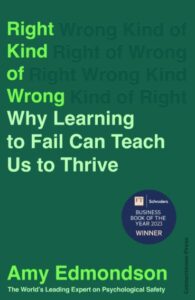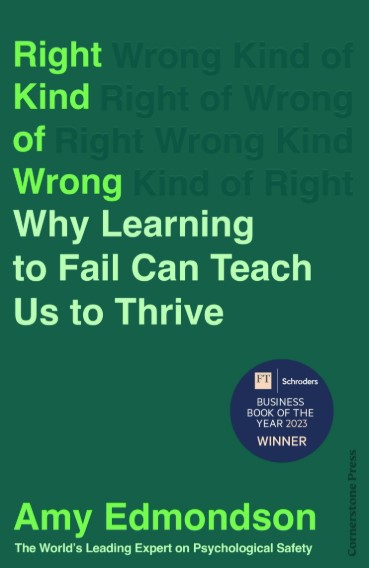
In a world that often says “never fail” or conversely, “fail fast, fail often,” it can be hard to know where to stand. Yet, as Harvard Business School professor Amy Edmondson argues in Right Kind of Wrong: The Science of Failing Well, the key isn’t simply to avoid failure or embrace every mistake indiscriminately — it’s to fail well. In other words, to distinguish between failure that is wasteful and failure that is valuable.
Here’s my detailed breakdown of the key insights, and how you can apply them to your life, work or team.
1. Understanding Failure: What It Is—and What It Isn’t
Edmondson makes clear definitions:
- Errors or mistakes are unintended deviations from a known standard — for example, putting milk in the cereal cupboard or chopping off the wrong leg (we hope!);
- A failure is an outcome that deviates from the desired result — the plan did not succeed;
- A violation is a deliberate action that causes harm (so that is not the kind of “constructive failure” we’re talking about).
This nuance matters because if everything we label “failure”, then we lose meaning and we cannot learn properly.
2. The Three Archetypes of Failure
Edmondson divides failures into three categories:
- Basic failures: These occur in known territory, are mostly preventable, happen because of neglect, inattention, complacency or skipping standard safeguards. Learning from these is limited because they reflect known standards you should already meet. Using checklists or routines often helps here.
- Complex failures: These occur when many moving parts, interdependencies, unpredictable events, or system-level issues come into play. They are hard to prevent entirely, because they include multiple causes, external factors, and novelty in scale. The key is early detection of weak signals, good systems awareness and rapid response.
- Intelligent failures: These are the right kind of wrong. They occur when you’re venturing into new territory, when hypothesis‐driven experiments are appropriate, when you take minimal risk, when you are ready to learn. The output is valuable information that you couldn’t get otherwise. If you’re innovating or changing the game, you’ll see intelligent failures.
In short: avoid or minimise basic failures, contain or mitigate complex ones, encourage intelligent ones.
3. The Role of Psychological Safety
What makes it possible to learn from failure is the environment. Edmondson’s long-term research into psychological safety shows that when people feel safe to speak up, to admit mistakes, to ask questions, and to challenge assumptions, then organisations learn faster, adapt better, and perform stronger. Without psychological safety, errors are hidden, blame takes over, and learning is stunted.
Psychological safety is not about being soft or okay with mediocrity — you can still have high standards and high performance while being safe for interpersonal risk-taking. It simply means you create the conditions where people can say: “I’m not sure about this”, “I messed up”, “Here’s what I’m learning”.
In practice: Leaders can frame work as a learning endeavour, encourage early warning signals, explicitly invite dissent, reward speaking up, and ensure mistakes are analysed for learning, not punishment.
4. Mindsets & Personal Reflections
On the individual level, there are several mindset shifts:
- Recognise that risk-taking is part of progress. If you’re only playing not to lose you stay safe, but you may also stay stagnant.
- Reframe failure: For example, athletes often show that the bronze medallist is happier than the silver because they frame their result differently — they say, “I made the podium” rather than “I almost got gold”. How you view your outcome matters.
- Don’t linger in shame (“I am bad”) — instead use guilt (“What I did was not good, I will improve”). Shame is counterproductive and hides learning; guilt drives accountability and change.
- Ask: “How do I know I’m right?” — challenge your assumptions; avoid confirmation bias, the sunk cost fallacy, and temporal discounting (the tendency to downplay future consequences compared to immediate ones).
- Be willing to experiment: In familiar tasks you might want flawless execution; in new tasks you need a learning mindset, not just an execution mindset.
5. System Thinking & Wider Implications
One of the rich themes is thinking beyond your immediate task:
- Use system awareness: What consequence does my action have on other people, downstream processes, supply chains, future demand?
- Be alert to unintended consequences: Efficiency gains (e.g., huge ships, mega-ports) might come at the cost of fragility in other parts of the system, as seen in global logistics bottlenecks.
- Avoid workarounds that look clever in the short term but hide underlying system issues—e.g., nurses borrowing sheets from another ward might keep things working, but the root cause remains unsolved.
Thus, embed constancy of reflection: “Who/what else will be affected, and what might happen in the future?”
6. Practical Practices to Implement
Here are ways you can put these ideas into action:
- For routine tasks: Use checklists, pause and think about why you’re doing each step, especially when you’re in autopilot mode.
- For innovation or new work: Frame clear hypotheses, keep experiments small, budget time and resources for learning, decide in advance when to stop the experiment.
- In teams: Build a culture of speaking up; use “after action reviews” that focus on learning, not blame; lead with curiosity (“What did we learn?”) not accusation.
- For failures: When things go wrong, ask: What happened? What caused it (multiple factors)? What can we learn? What will we do differently?
- Pay attention to your internal dialogue: If you hit a setback, ask yourself: “Am I focusing on what I should have done better, or am I stuck in shame?”
- Encourage success feedback: Praise what people did right, not just what they did wrong. That reinforces learning and improvement.
- Reflect on context: If you are in a privileged position you might have more freedom to fail; for others, failure might carry heavier consequences. Be thoughtful and inclusive in how you encourage risk-taking.
7. Why This Matters
In our fast-changing world, rigid models of execution (just do it) no longer suffice. Uncertainty, complexity, rapid change mean you must learn, adapt, experiment. Organisations that cling to “never fail” end up hiding problems until they become catastrophes. Organisations that blindly adopt “fail fast” but without structure end up chaos. The right approach is to fail well.
Whether you’re building a business, leading a team, designing a product, or simply navigating your personal life and career — failing well means you turn your mistakes into stepping stones not stumbling blocks.
In sum: This book (and the ideas behind it) gives us a roadmap for leveraging our human fallibility as a strategic advantage.
In Summary
If you take only one thing from this post: embrace the idea that failure is inevitable, but how you fail, what you do after, and the environment you’re in make all the difference. Create space for intelligent failure, reduce the basic mistakes, and learn swiftly when things go wrong. You’ll build stronger teams, smarter experiments, and more resilient organisations — and you’ll be more human in the process.
Be sure to check out my video summary which goes into more detail!
Part 1:
Part 2:
Part 3: