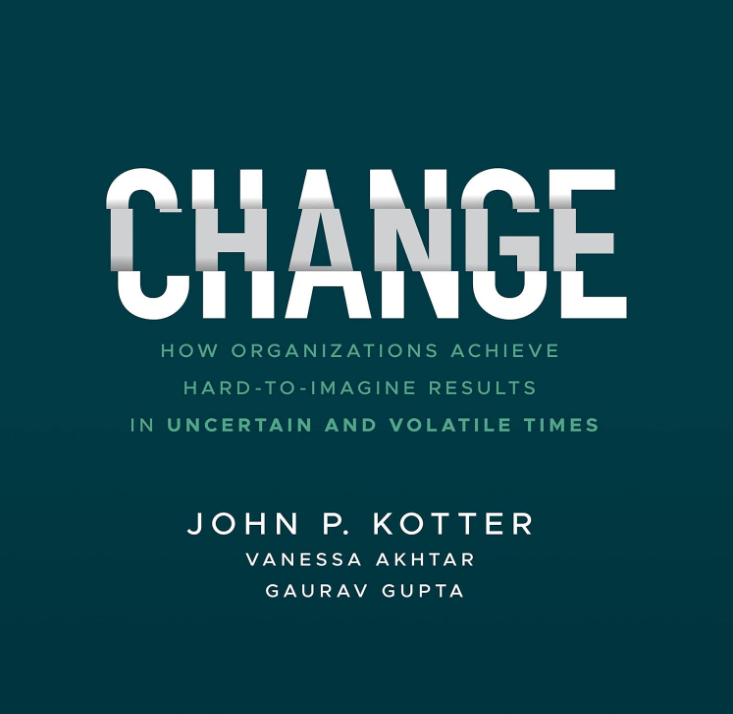
We live in a world where change isn’t just rapid—it’s unpredictable and disruptive. In their 2021 book Change, John P. Kotter, Vanessa Akhtar, and Gaurav Gupta argue that incremental improvements no longer suffice. Organizations must develop an entirely new approach to change—one rooted in science, leadership, and agility.
Why today’s change challenge is unprecedented
External volatility—from pandemics to AI disruption—has accelerated dramatically, while organizations continue using slow, bureaucratic change practices. This gap between external turbulence and internal adaptability endangers firms that rely on stability over transformation.
Core principles
- Urgency: “Have-to” and “Want-to”
Leadership must craft urgency that connects with both head and heart—rational necessity and emotional engagement—to motivate action beyond fear or compliance. - Dual operating system
Combine traditional hierarchies (stable and predictable) with loosely organized networks (innovative and agile). The latter drives change without disrupting reliable operations. - Diverse early movement
Start with a small, varied group of change agents. Their early wins build visible momentum that encourages wide participation. This moves beyond top-down data-driven models into broad, inspired leadership. - Strategy is change
Treat strategy as dynamic transformation rather than static plans. Involve broad input and make strategy continuously adaptable to shifting threats and opportunities. - Culture emerges from actions
Forget imposing culture from the top. Instead, let culture evolve from repeated new behaviors that deliver results, get imitated, and become habits. This bottom‑up evolution is more sustainable.
Leadership vs Management
Leadership and management are distinct yet complementary. Leaders inspire vision, direction, and alignment. Managers implement policies, structure, and execution. Large-scale change depends on both—but leadership must cascade beyond the top to all levels.
Conclusion: preparing for the “new normal”
Kotter et al. argue that constant volatility is not temporary but the new baseline. Organizations that can lead change from the middle, activate both emotional and rational buy-in, and run dual systems will thrive, while others merely survive.
Summary
- Apply urgency that blends logic and emotion
- Launch agile networks alongside hierarchies
- Empower more leaders, not just managers
- Treat strategy as flexible transformation
- Let culture emerge from effective behaviors
Implement these principles and you’re not just managing change—you’re mastering it.